Practical Mysticism 5: Understanding, Acceptance, Application with Focus on Understanding


Hi there! Today I’d like to talk about three components of spiritual awakening in the mystical practice of A Course a Miracles, The InfiniteWay, and in Mysticism in general as it was defined in both the Practical Mysticism blog post and video number 1 in this series. If you haven’t already read or listened to the Practical Mysticism post/video number 1 called “Defining Mysticism,” I would encourage you to do so, as it defines Mysticism in the way it’s used in these teachings and on this channel. The blog post can be found here: and the video can be found here: In the first four videos in this series, some foundational ideas were laid down which specifically pertained to A Course in Miracles and The Infinite Way. From here forward, the core principles of both teachings, as well of those of Mystical Christianity and Mysticism in general, will more or less be amalgamated into one cohesive presentation. 


So the three components to spiritual awakening in this practice are: understanding, acceptance, and application. All three components are essential, and if any of those components are lacking, then the process is weakened and delayed.


Of the three components—-understanding, acceptance, and application—-it’s the understanding and the application that will be the focus of the content of the Practical Mysticism channel, as these two components are where the sharing would be most helpful. Acceptance, or at least provisional acceptance, is largely up to the individual mind.


For today let’s focus only on understanding, or what I like to call right understanding or proper understanding. What is it we need to have proper understanding of? 


Firstly, it is essential to have the correct understanding of the nature of the mind, the nature of the world, and the relationship or connection between them. Stated concisely, a comprehensive understanding of the correct metaphysics is absolutely essential for both practice and for Truth Realization. The correct metaphysics are very radical compared to what we have been conditioned to believe. Nevertheless, as radical as they seem to be, they must be accepted. It’s possible for one to hear and even to understand the metaphysics, but that doesn’t mean one is necessarily going to buy into them! I don’t even advocate blindly buying into what someone is teaching; that’s kind of what got us into trouble in the first place! But what I do suggest is provisionally accepting the principles and metaphysics, applying them in practice, and proving or disproving them to yourself. 


In addition to having correct understanding of the metaphysics of the mind and of the world, another absolutely essential aspect of right understanding is apprehending the nature of God, the Spiritual Universe of Reality, and the nature of our abstract Spiritual Identity as created by God, as One with God. The belief that we are in any way separated from God must be seen as erroneous.
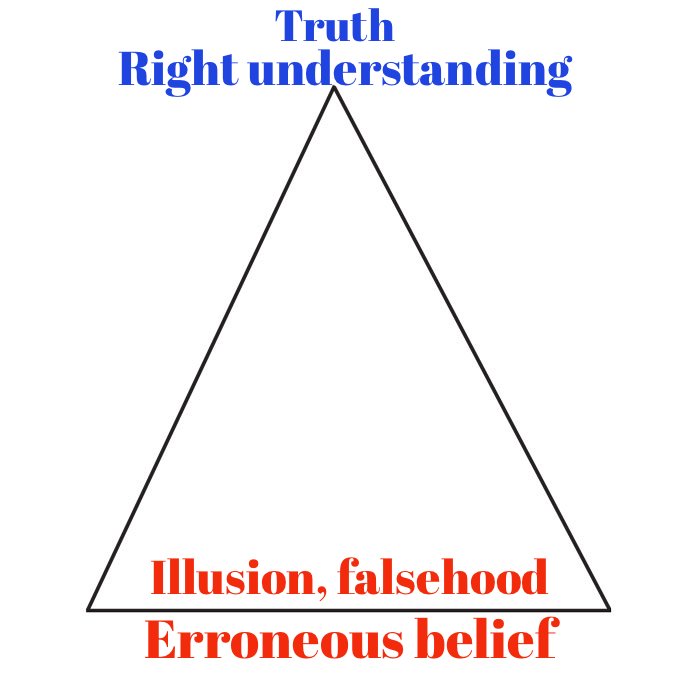


In order to more easily comprehend right understanding vs erroneous belief, 

let\"s start once again with the basic triangle diagram, shown above. As stated in previous posts , this triangle represents the split or divided mind. In its present condition, meaning asleep and dreaming of a world of separation and multiplicity, the mind seems to be divided into two parts which could be roughly classified as Truth and illusion, or Truth and falsehood, which includes Right understanding vs erroneous belief. 


The bottom of the triangle represents the erroneous beliefs and perceptions—in other words, the misunderstandings— that are present when the mind is asleep in the dream of separation. Firstly, the bottom-of-the-triangle perspective erroneously proclaims that I am a separate, objectively existing human being in a great big, objectively existing universe of matter. I am a person and everything in the world is outside of me, and exists apart from me. Furthermore, I am separated from my Creator or Source. This perspective sees and believes in multiplicity, division, and the solidity of matter. The bottom-of-the-triangle perception is five sense perception, and the mind that dwells in this state of consciousness believes in the evidence reported by the five senses. At the bottom of the triangle, in the consciousness of humanhood, the mind always seeks outside itself, believing that safety, supply, love, and all things come from without rather than within. Furthermore, this perspective believes that what is reported by the five sense mind is reality, and that this reality was created by God, or in the case of the atheist, that the apparent material universe is reality and that there is no Creator. 


Now let’s look at the contrasting perceptions at the top of the triangle, where the mind dwells in a consciousness of Truth. The top-of-the-triangle perspective sees, or understands, that what appears to be an objectively existing world of matter is an unreal mental world of images; a false universe of five sense impressions. Furthermore, this false sense universe is seen as one tapestry of illusion. In other words, top-of-the-triangle perception unifies the world of images as one illusion. Hierarchies among the illusory images are not acknowledged. 


The perspective at the top of the triangle is an attitude of knowing, and trusting in, an invisible Spiritual Reality of Oneness that is present here and now, despite any seemingly contrary evidence provided by the five senses. It is understanding that the apparent world of form is just an insignificant mental veil over the ever-present Spiritual Universe of Reality. This perspective sees the apparent world as unreal, as a mental dream dreamt by a mind that believes in separation and opposites, and is in no way a creation of God.
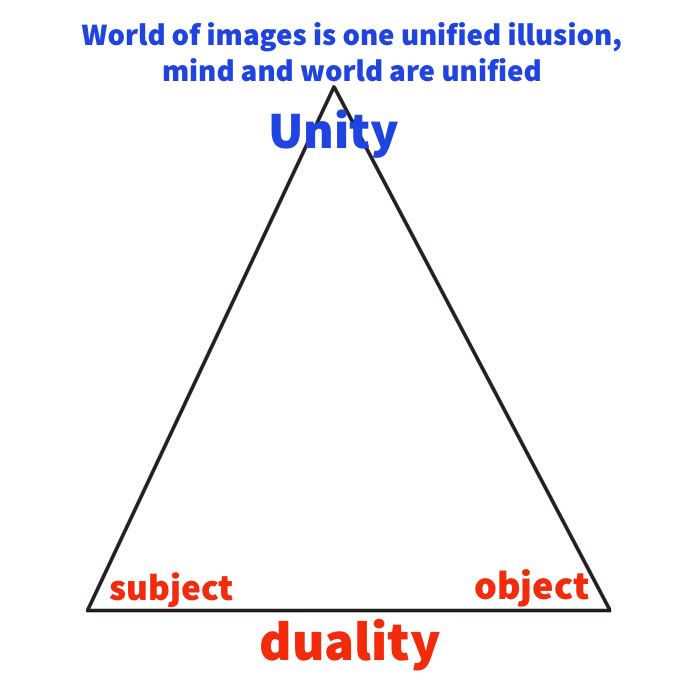


In order to flesh out further the difference between correct understanding and erroneous belief, I’d like to highlight one of the major foundational errors in thinking that must be corrected in order to properly apply the principles, and to awaken to Truth. 


At the level of what appears to be form, when we are identified as a body or a person, it seems that we are in a dualistic, subject-object relationship with everything.  If I’m identified as a body existing in a material universe, then I am the subject and everything else in the universe, including other people, are the objects. But this perception is an error. Truly there is no subject-object split at the apparent form level. In actuality, it is more akin to what we experience in a nighttime dream. When we are dreaming at night, it seems as if our dream character is the subject and all the other people and things in the dream are objects, when in actuality it’s one seamless, unified dream, occurring in the mind. The daytime experience is the same; it is one unified dream occurring only in the mind of the dreamer. 


Now, not only is there no subject-object split at the apparent form level as mentioned, but there is truly no subject-object split at the mind level either. Let’s look further into what this means. In some spiritualities we may be taught that our identity is mind or consciousness, sometimes called subject, and that the appearances of the world are the objects of that consciousness. Or, we may hear about cause and effect, with mind being cause and the world of images being effect. However, in actuality cause and effect are together, consciousness and its objects are together. There is no inner and outer. In other words, there is no mind as inner and world as outer. Another way of saying this is offered by a Course in Miracles in the following quote: “Ideas leave not their source,”  meaning that the mental world of ideas is still in the mind of the thinker. The world is not actually projected from the mind, but it’s all mind and only mind. This understanding is a top-of-the-triangle perspective. It’s the dreamer of the dream perspective, with the dreamer being the mind. Not an individual mind, but the one mind dreaming of a world of opposites. The dreamer and the dream are unified. Repeat, the dreamer and the dream are unified. Mind is the dreamer and the dream. 


Next, we need right understanding of the difference between the finite mental illusion of a world, and the Infinite Spiritual Universe of Reality. 
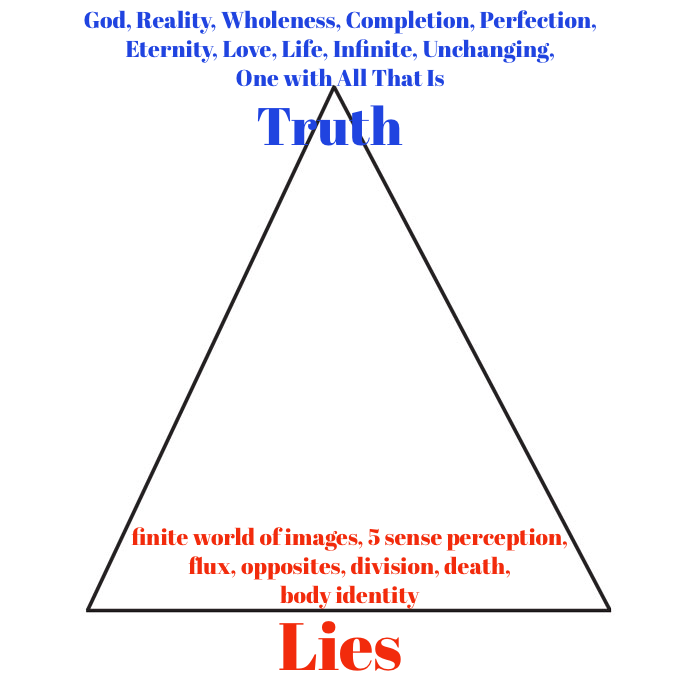


The Infinite Spiritual Universe of Reality, also known as God, is present here and now, though invisible to the senses. It is a Reality of Wholeness, Completion, Perfection, Eternity, and Love. It isn’t affected in any way by the appearances of this world. It cannot be assailed, diminished, altered, or compromised in any way. It is Infinite and Unchanging. By contrast, the finite mental world of appearances is in constant flux, always changing and ever unreliable. It is a world of opposites, of division, and death. It is a world solely of five sense perception; seeing, hearing, touching, tasting, and smelling. These senses do not provide testimony of the ever present invisible Reality of Oneness here now. The evidence of the five senses is a lie, it is lying about Reality, and attempting to replace Reality with its world of images. The good news is it hasn’t succeeded! Infinite Reality is present here now and in this practice, it is to this Reality that we give our fidelity. It is our practice to not be fooled by the evidence of the senses. It is our practice to never give credence or power to any five sense evidence, and to put our trust completely in God.


When we trust the evidence of our senses, it tells us that our identity is a body, or a human being. When we trust in God, He tells us that our Identity is the Infinite Spiritual Universe of Reality because we are one with Him who is that very Reality.


The finite mental illusion of a world is just that: an illusion. An unreal dreamlike world with no substance, no existence, and no life. It is a temporary, flimsy veil of nothingness trying to take the place of Reality. How wonderfully laughable! The finite mental illusion of a world has no intrinsic power, and it is our practice to not invest it with any power whatsoever. We rest in the fact that Truth is True, and only Truth is True. Amen! 


The application of the principles discussed here will be the focus of other posts, but in short, it could be said that the application would include the following basic practices, though this list is not exhaustive:


  1. Giving no credence or power to any evidence of the 5 senses. Giving no power to any so-called person, place or thing. Seeing the world of images as one neutral tapestry of illusion and therefore not reacting to anything.



  1. No longer seeking outside for safety, supply, love, or for anything at all.


  1. Observing behavior in order to bring to awareness the motivation for the behavior, and no longer engaging in behaviors motivated by fear, lack, or littleness.


  1. Raising to awareness all beliefs, thoughts, and concepts associated with humanhood and the false world, and letting them go.


  1. Trusting in the ever present Infinite Invisible Spiritual Reality of Oneness. Stated alternatively as trusting in God, and/or trusting in the True Nature of Yourself, that nature being Wholeness and Completion, being Self Sustaining and Self Maintaining, being Infinite, Eternal, and Joyful. 


That’s all for today. We’ll continue to dive deeper into the principles and practices in upcoming posts. If you have any questions relating to this material, please ask them in the comment section and I will try to address them.  Bye for now, and Glory to the One Reality! 


The audio presentation of this blog post, including images and diagrams, can be found below and on the Practical Mysticism YouTube channel:


Practical Mysticism 4: Divided Mind Basics of The Infinite Way


Today I’d like to look at the triangle metaphor as it would relate specifically to the teachings of The Infinite Way as taught by both Joel Goldsmith and Herb Fitch. The Infinite Way shares basic metaphysics, principles, and practices with A Course in Miracles, but the terminology in some cases is different, so let’s look at the triangle metaphor using Infinite Way language. 


The triangle symbol is a metaphor for what is referred to in The Infinite Way as the divided mind. The divided mind is a way of describing the condition of the mind when it is in a state of ignorance, divided between a consciousness of matter, mortality, duality, and illusion, and a consciousness of Spirit, Immortality, Oneness, and Truth. The mind is split between these two opposing states, and the aim of the Infinite Way is to have the mind come to rest in the consciousness of Truth alone. 


In the consciousness of illusion, the mind is identified as a body in a world of matter, believing it is separate from its Creator, and unaware that beyond the five sense universe is an Infinite invisible Universe of Perfection. Furthermore, in this state of ignorance, the mind is unaware that it is the maker of the five sense universe, believing instead that the seeming material universe has an objective existence apart from the mind. 


When the mind resides in the consciousness of Truth, which is symbolized by the top of the triangle, the mind knows itself as mind, or consciousness, and no longer identifies itself as a human being. The top of the triangle perspective also understands that what appears to be a material universe of matter is actually a mental universe of images which is a veil blocking the Infinite Spiritual Universe from awareness. The mind understands that the sense universe of images is a misperception of the Spiritual Universe of God. The mind dwelling in the consciousness of Oneness knows truly that God is All and that the universe of appearances is actually nothingness. 


This mind, purified of all thoughts, beliefs, and concepts of humanhood and a false universe, knows its identity as One with its Creator, as One with All that Truly Is. The undivided mind knows that the apparent material universe has no objective existence apart from mind. It knows it is the maker of the world of images, and that this world of images is solely mind, similar in substance to a nighttime dream. Knowing the falsity and nothingness of this mental world of duality, the mind never gives credence or power to any of the images. From this elevated state of mind we know ourselves as the Christ and we have dominion over the world of images.


The goal of The Infinite Way practice is for the mind to be undivided, purified of all beliefs and concepts associated with humanhood and the false universe, and resting in the abstraction of our Immortal, Infinite, True Identity. 


The Infinite Way uses many different terms to describe the states of mind at both the top and the bottom of the triangle, and I’ll incorporate more of these terms in future posts when we dive deeper into The Infinite Way and into Practical Mysticism. I hope you found this content helpful. Thank you, and peace to you. 


The audio presentation of this blog post, including images and diagrams, can be found below and on the Practical Mysticism YouTube channel:


Practical Mysticism 3: Split Mind Basics of A Course in Miracles


Today I’d like to discuss the triangle as a metaphor for the split mind as it would be applied specifically to the teachings of A Course in Miracles. In A Course in Miracles,  the origin of the seeming separation from God and the making of a world of images is given in the following quote: “Into Eternity where all was one there crept a tiny mad idea at which the Son of God remembered not to laugh.” This tiny mad idea could generally be defined as the idea of separation. Now, I say the seeming separation from God and the making of a world of images because whilst we may start on our path of awakening feeling separate from our Creator and we may believe in the reality of a world of images, the ultimate message of A Course in Miracles is that “the separation never happened,”and, that “there is no world!” But Because we start out believing we are separate human beings existing in a real universe of matter, A Course in Miracles offers us a way out of this delusion through the practice of forgiveness, and the classroom or arena where this practice takes place is in the split mind. 


Let’s start with some quotations from the Clarification of Terms in A Course in Miracles:


“In this illusory state, the concept of an "individual mind" seems to be meaningful. It is therefore described in the course as if it has two parts; spirit and ego.”


“Spirit is the part that is still in contact with God through the Holy Spirit, Who abides in this part but sees the other part as well.” “The other part of the mind is entirely illusory and makes only illusions.”


“The mind can be right or wrong, depending on the voice to which it listens.

 Right-mindedness listens to the Holy Spirit, forgives the world, and through Christ\"s vision sees the real world in its place. This is the final vision, the last perception, the condition in which God takes the final step Himself. Here time and illusions end together.”


“Wrong-mindedness listens to the ego and makes illusions; perceiving sin and justifying anger, and seeing guilt, disease and death as real. Both this world and the real world are illusions because right-mindedness merely overlooks, or forgives, what never happened. Therefore it is not the One-mindedness of the Christ Mind, Whose Will is one with God\"s.”


“In this world the only remaining freedom is the freedom of choice; always between two choices or two voices.” 


So in the mind that is dreaming of separation, generally the practice is to choose the top-of-the-triangle perspective and it’s concomitant thought system, and to release the false perception typified by the bottom of the triangle, as well as the entire thought system that stems from it. 


The practice of forgiveness, or the practice of choosing to listen to the voice of the Holy Spirit, or the practice of unifying perception, all entail a rising in consciousness or mind from the false thought system of illusion and linear time into the consciousness of unified perception, seeing the entire ego thought system and the world of images as false, and understanding that mind is the dreamer of the world of images. This is symbolized by the vertical axis in the diagram above. The practice of forgiveness, also called the miracle or a shift in perception, takes the mind off of the horizontal timeline where it is identified as a human being moving through time and space, and elevates it to the consciousness of Truth. A partial quote from ACIM Chapter 1 The Meaning of Miracles demonstrates this principle: “...the miracle entails a sudden shift from horizontal to vertical perception.” 


In order to practice the shift in perception called the miracle, or to practice forgiveness as taught in A Course in Miracles, you must begin with accepting yourself as mind and not as a body. To repeat, you must think of yourself as mind. So your area of focus and practice is the split mind, symbolized by the triangle above. This could also be described as working at the level of cause, as mind is causative, and the world of images is effect.


Mind, represented by the triangle, is the agency through which we return to God or to Reality, which according to ACIM, transcends the split mind and the dualistic world of images. Please note that I use the terms God and Reality with a capital “R” interchangeably as they are used interchangeably in A Course in Miracles. Truly, there is no actual return to Reality because we never left, but while the mind is asleep and dreaming of a world of images, it is with the split mind that we must work. 


The Holy Spirit is described in a Course in Miracles as the memory of God in our mind, and as the bridge to restoring our awareness of Reality.


The Condition of the mind required for return to God is peace, is unified perception, is healing the split mind, is the real world perspective. Repeating an earlier quote from A Course in Miracles: “This is the final vision, the last perception, the condition in which God takes the final step Himself. Here time and illusions end together.” The goal of the practice of forgiveness is to bring our minds to that condition. 


Now I’d like to talk a bit about one of the major foundational errors in thinking that must be corrected in order to bring the mind to the condition of peace and to a unified perception of the world of images.


At the level of effect, or what appears to be form, when we are identified as a body or a person, it seems that we are in a dualistic, subject-object relationship with everything.  If I’m identified as a body existing in a material universe, then I am the subject and everything else in the universe, including other people, are the objects. But this perception is an error. Truly there is no subject-object split at the apparent form level. In actuality, it is more akin to what we experience in a nighttime dream. When we are dreaming at night, it seems as if our dream character is the subject and all the other people and things in the dream are objects, when in actuality it’s one seamless, unified dream, occurring in the mind. The daytime experience is the same; it is one unified dream occurring only in the mind of the dreamer. Identifying ourselves as that dreamer is the goal of the forgiveness process of A Course in Miracles. 


Not only is there no subject-object split at the apparent form level as mentioned, but there is truly no subject-object split at the mind level either. Let’s look further into what this means. In some spiritualities we hear about our identity as consciousness or awareness and about the appearances of the world as the objects of consciousness. Even in A Course in Miracles, we hear about cause and effect, with mind being cause and the world of images being effect, or we hear about the mind projecting the world. However, in actuality cause and effect are together. There is no inner and outer. In other words, there is no mind as inner and world as outer. Another way of saying this is offered by ACourse in Miracles in the following quote: “Ideas leave not their source,”  meaning that the world of ideas is still in the mind of the thinker. The world is not actually projected but it’s all mind and only mind. This understanding is a top-of-the-triangle perspective. It’s the dreamer of the dream perspective. “You are the dreamer of the world of dreams.” Jesus said.  The “you” he is referring to is not the body or personality, it is the mind. The one mind dreaming of a world. The dreamer and the dream are unified. You, as mind, are the dreamer and the dream. 


Ultimately, this dreaming mind is illusion as well, but coming to this unified perception, this dreamer of the dream perspective, is as far as we can go, so to speak, while the dream is still in awareness. God takes the last step in our return to Him. Our concern is coming into the unified perception of the dreamer of the dream perspective, which is symbolized by the top of the triangle. Also, this perspective has dropped all thoughts, beliefs, and concepts associated with the erroneous beliefs in a human identity and a world of matter. 


A Course in Miracles states that “the sole responsibility of the miracle worker is to accept the Atonement for himself.” Atonement in A Course in Miracles is the concept that the separation from God never happened and that an unreal world of images has no true existence. So the aim of mystical practice is to accept that the perceived separation from God never happened, and that I am still as God created me as Christ, despite any seeming five sense evidence to the contrary. Metaphorically, acceptance of the Atonement could be described as mind dwelling at the apex of the triangle, where True Freedom abides; it is a state of mind that is still, expansive, and peaceful. 


I hope the content here has been in some way helpful. Thank you.


The audio presentation of this blog post, including images and diagrams, can be found below and on the Practical Mysticism YouTube channel:


Featured Post

Practical Mysticism 5: Understanding, Acceptance, Application with Focus on Understanding

Hi there! Today I’d like to talk about three components of spiritual awakening in the mystical practice of A Course a Miracles, The Infinite...